Earth.Org · Data journalism
Shifting Baselines and the Elusiveness of Climate Change
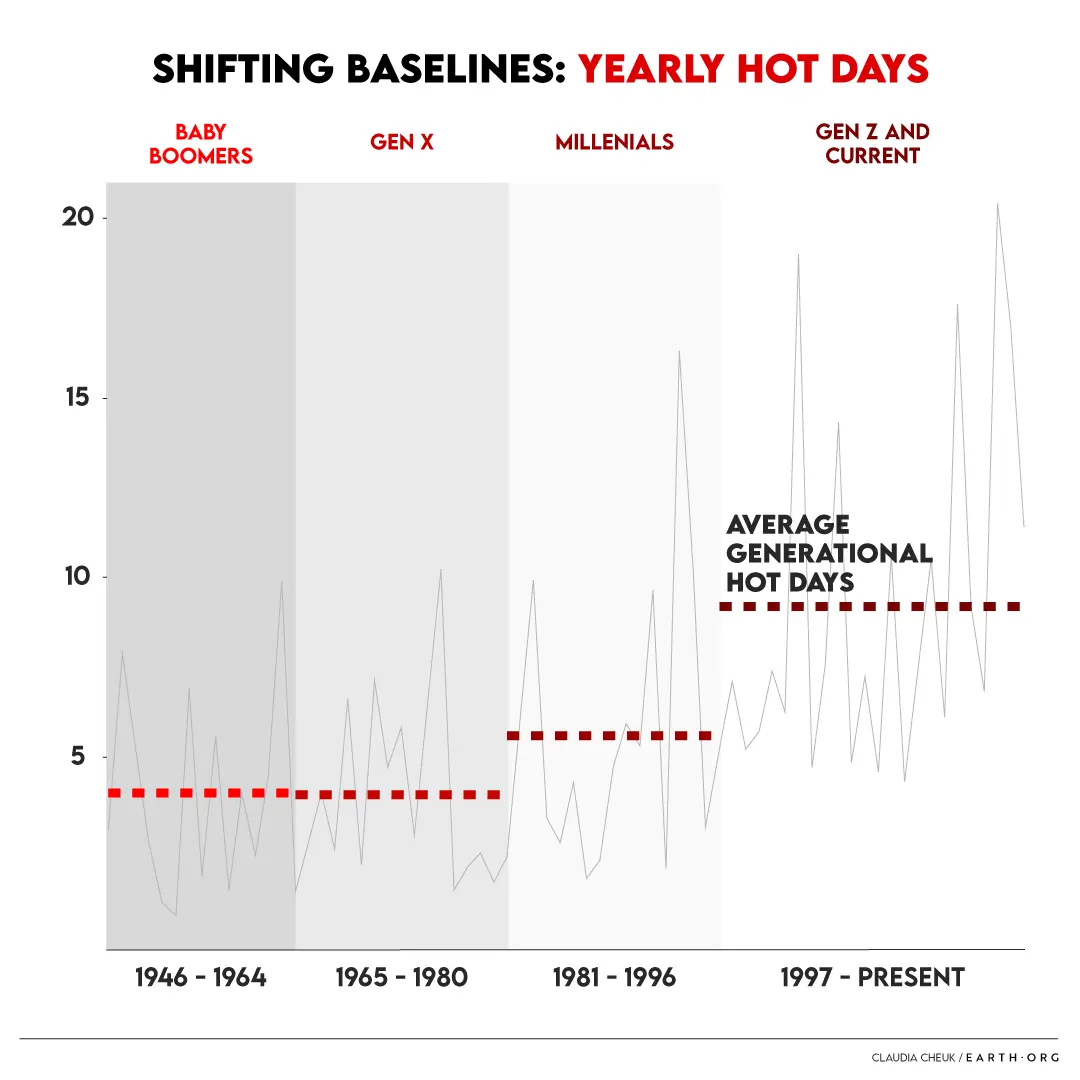
Why does gradual climate change go unnoticed? The piece compares what each generation in Germany has experienced as normal: hot days per year rose from about 4 for Baby Boomers to about 9 for Gen Z, and frost days fell by about 16 over the period.
- Published
- Earth.Org, 14 April 2021
- My role
- Data Journalism Team Lead (2020 to 2022)
- Tools
- Python and Adobe Illustrator
What it shows
Why does gradual climate change go unnoticed? The piece compares what each generation in Germany has experienced as normal: hot days per year rose from about 4 for Baby Boomers to about 9 for Gen Z, and frost days fell by about 16 over the period.
What I did
Data Journalism Team Lead at Earth.Org (January 2020 to January 2022), leading a volunteer data team of between 5 and 15 people. For each piece I conceptualised it, did the research and directed the number crunching and the final design. A graphic designer handled final production. Data analysis by Daniel Müller-Komorowska.
Data and methods
Daily weather records from the German weather service since 1946. Hot days are days at or above 30°C and frost days are days with a minimum below 0°C, averaged over the early life of each generation (Baby Boomers, Gen X, Millennials, Gen Z).
Full sources are listed in the original article.
Tools
Python and Adobe Illustrator.
Who I worked with
Earth.Org's data team was made up of volunteer contributors from around the world, between 5 and 15 people at a time. Data analysis by Daniel Müller-Komorowska.
Limits
The article says plainly that one country and one metric over a short period cannot demonstrate climate change on their own. It illustrates a perception effect that the wider research has established.